Styrene Acrylic Emulsions for Cementitious Waterproofing – Understand Better, Choose Better
In modern water-based waterproofing systems, especially cementitious waterproofing, styrene acrylic (SA) emulsions play a central role. They largely determine whether the coating is elastic, watertight and crack-resistant – even though, in many formulas, they stay “hidden” behind cement, fillers and other additives.
This article gives a concise overview of the role of styrene acrylic emulsions in waterproofing, and how AMIBOND has developed AMISTAC 5100 for two-component (2K) cementitious systems.
1. What is a styrene acrylic emulsion in construction applications?
A styrene acrylic emulsion is a waterborne copolymer produced from two main monomer families:
- Styrene – increases film hardness, improves water resistance and helps optimize cost.
- Acrylates (e.g. butyl acrylate, 2-EHA, MMA) – tune flexibility, elasticity and weathering resistance.
The result is a white, milky polymer binder that:
- Acts as the liquid component (Part A) in 2K cementitious waterproofing systems.
- Modifies repair mortars, bonding slurries, tile adhesives and gap fillers.
- Can also be used in water-based waterproofing paints and wall coatings.
2. Why is styrene acrylic well-suited for elastic waterproofing?
For elastic waterproofing and repair systems, styrene acrylic emulsions are widely used because they offer a strong balance between performance and cost.
Key performance attributes
- High elasticity (low Tg) Using low-Tg acrylates gives a soft, flexible polymer film with good elongation and crack-bridging ability – the number-one requirement for cementitious waterproofing membranes.
- Excellent cement compatibility The emulsion remains stable when mixed with cement, without coagulation or phase separation. Workability is maintained, and after curing, the polymer forms a continuous elastic network interlocked with the cement matrix.
- Water and alkali resistance A well-designed SA polymer shows low water absorption and withstands the highly alkaline environment of cement, making it suitable for wet areas, balconies, tanks and other demanding locations.
- Strong adhesion Improves adhesion between the waterproofing layer and the concrete/cement substrate, and also between the waterproofing layer and the finishing layer above (e.g. tiles).
- Cost effectiveness Compared with pure acrylic, styrene acrylic emulsions provide a very attractive performance-to-cost ratio, supporting a wide range of formulations from standard to mid/high-performance systems.
3. Typical application segments for SA in waterproofing and repair mortars
3.1. Two-component (2K) cementitious waterproofing
This is the most typical and high-volume application:
- Part A (liquid): styrene acrylic emulsion + additives.
- Part B (powder): cement + fine fillers + mineral additives.
When Part A and Part B are mixed on site:
- The cement phase hydrates and provides mechanical strength, compressive and abrasion resistance.
- The SA polymer forms an elastic, continuous film, providing flexibility, crack-bridging and water tightness.
Typical end uses:
- Internal wet areas: bathrooms, toilets, wash areas, kitchens (under tile).
- Balconies and exposed slabs covered with a protective tile layer.
- Certain tanks and retaining structures, depending on the detailed formulation and specification.
3.2. Vertical wall waterproofing
For vertical walls (facades, external walls, rain-exposed surfaces), styrene acrylic can be used in:
- Waterproofing paints and façade coatings,
- Thin cementitious waterproofing layers applied on vertical substrates.
In this segment, the SA polymer often has a medium to higher Tg, to:
- Form a harder, less tacky film, Improve dirt pick-up resistance and cleanability.
- While maintaining water and alkali resistance and minimizing chalking.
3.3. Repair mortars, tile adhesives and gap fillers
Styrene acrylic emulsions are also used as polymer modifiers in:
- Structural and non-structural repair mortars: Improve bonding between old and new concrete, increase flexural strength and reduce shrinkage.
- Cementitious tile adhesives: Enhance adhesion and allow the adhesive layer to accommodate movement between substrate and tile.
- Gap fillers and skim coats: Improve surface smoothness, crack resistance and adhesion to mineral substrates.
4. Technical parameters to consider when selecting an SA emulsion
For manufacturers of construction chemicals, choosing the right styrene acrylic emulsion is critical. Important parameters include:
- Glass transition temperature (Tg) & Minimum film-forming temperature (MFFT)
- Elastic waterproofing and repair systems require low Tg / low MFFT → soft, flexible films with good crack-bridging.
- Wall coatings, primers and façade paints typically use medium to higher Tg → harder films, reduced blocking and better scrub resistance.
- Cement compatibility and alkali stability The emulsion must remain stable in the presence of cement and high pH, without coagulation or excessive thickening, and without overly short pot life.
- Particle size Smaller particles help penetrate capillaries and pores in concrete/mortar, improving adhesion. This is especially beneficial for primers and bonding slurries.
- Water absorption and surfactant system The polymer and surfactant package should be designed for low water uptake and long-term durability, even under permanent or intermittent water exposure.
5. AMIBOND’s solution: AMISTAC 5100 for 2K cementitious waterproofing
Based on hands-on experience with construction emulsions, AMIBOND has developed AMISTAC 5100 as a styrene acrylic emulsion dedicated to 2K cementitious waterproofing and related systems.
5.1. Product positioning
AMISTAC 5100 is designed to:
- Act as the liquid component (Part A) in two-component cementitious waterproofing membranes,
- Provide high elasticity, crack-bridging, water resistance and strong adhesion on cementitious substrates.
With its low Tg and very low MFFT, AMISTAC 5100 helps the membrane:
- Form a continuous film under normal application conditions,
- Maintain flexibility after the cement phase has fully cured.
5.2. Typical applications
AMISTAC 5100 is suitable for manufacturers of:
- 2K cementitious waterproofing membranes for:
- Internal wet areas: bathrooms, toilets, wash and service areas (under tiles),
- Balconies and exposed slabs that will be covered by tiles or other protective finishes.
- Polymer-modified repair mortars and bonding slurries.
- Cementitious tile adhesives where high adhesion and flexibility are required (depending on formulation and target class).
5.3. Key technical benefits
When correctly used in a suitable formulation, AMISTAC 5100 can:
- Increase elongation and crack-bridging capability of the waterproofing layer,
- Reduce water absorption of the system and improve long-term durability,
- Boost adhesion to concrete and cementitious substrates as well as to subsequent finishing layers,
- Offer a controlled pot life, keeping the A+B mixture workable and easy to apply on site.
5.4. Packaging and technical support
- AMISTAC 5100 is supplied as an aqueous polymer dispersion, in standard industrial packaging:
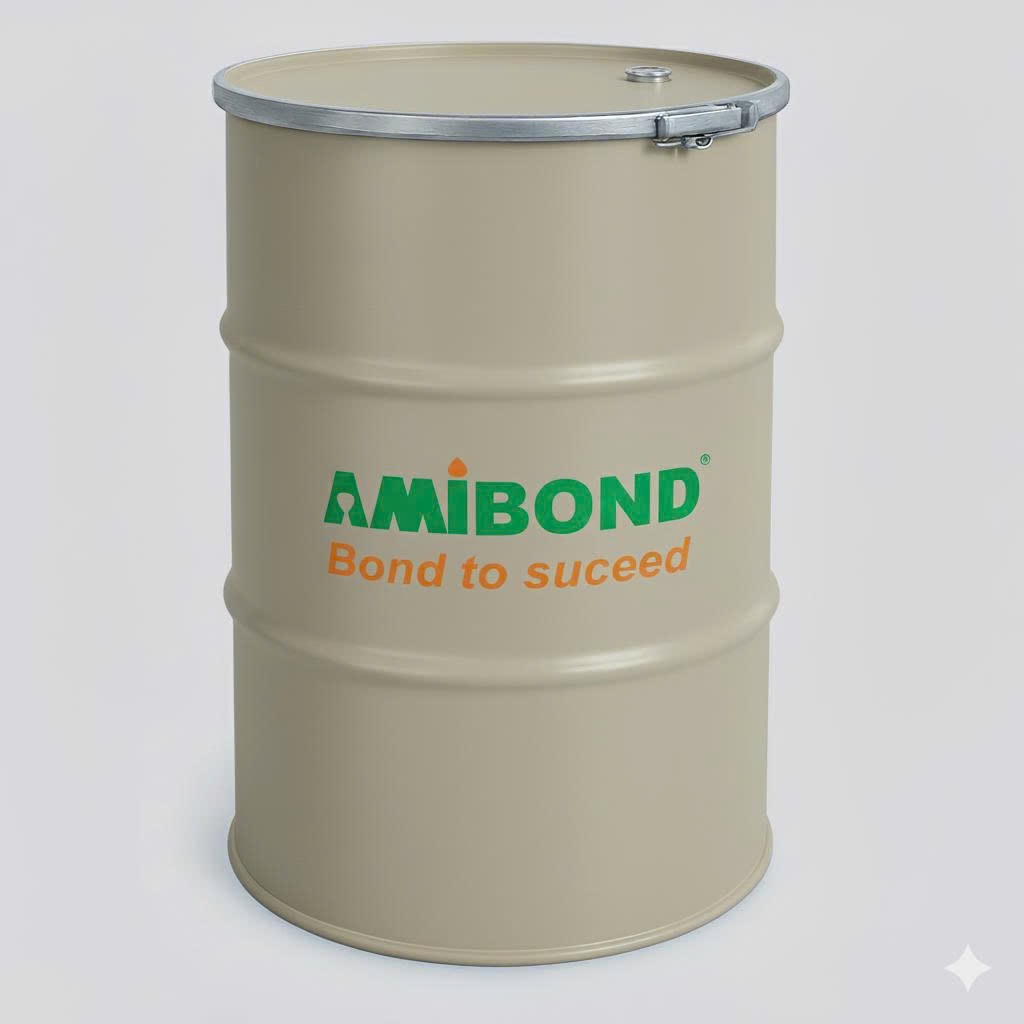
- 200 kg drums
- 1000 kg IBC tanks
- The AMIBOND team can support:
- Technical data sheets (TDS) and safety data sheets (SDS),
- Starting-point formulations for different waterproofing and mortar systems,
- Fine-tuning according to your specific application and local requirements.