PVAc Adhesive Systems in Industrial Production
A technical overview of polyvinyl acetate (PVAc) emulsion systems – a fundamental class of water-based adhesives valued for their reliable film formation, strong adhesion, and broad industrial adaptability.
Among water-based adhesive polymers, polyvinyl acetate (PVAc) remains one of the most established and widely used systems. Its ability to form continuous films and adhere strongly to cellulose-based or porous materials has made PVAc a cornerstone in many manufacturing sectors.
1. Composition and Structure
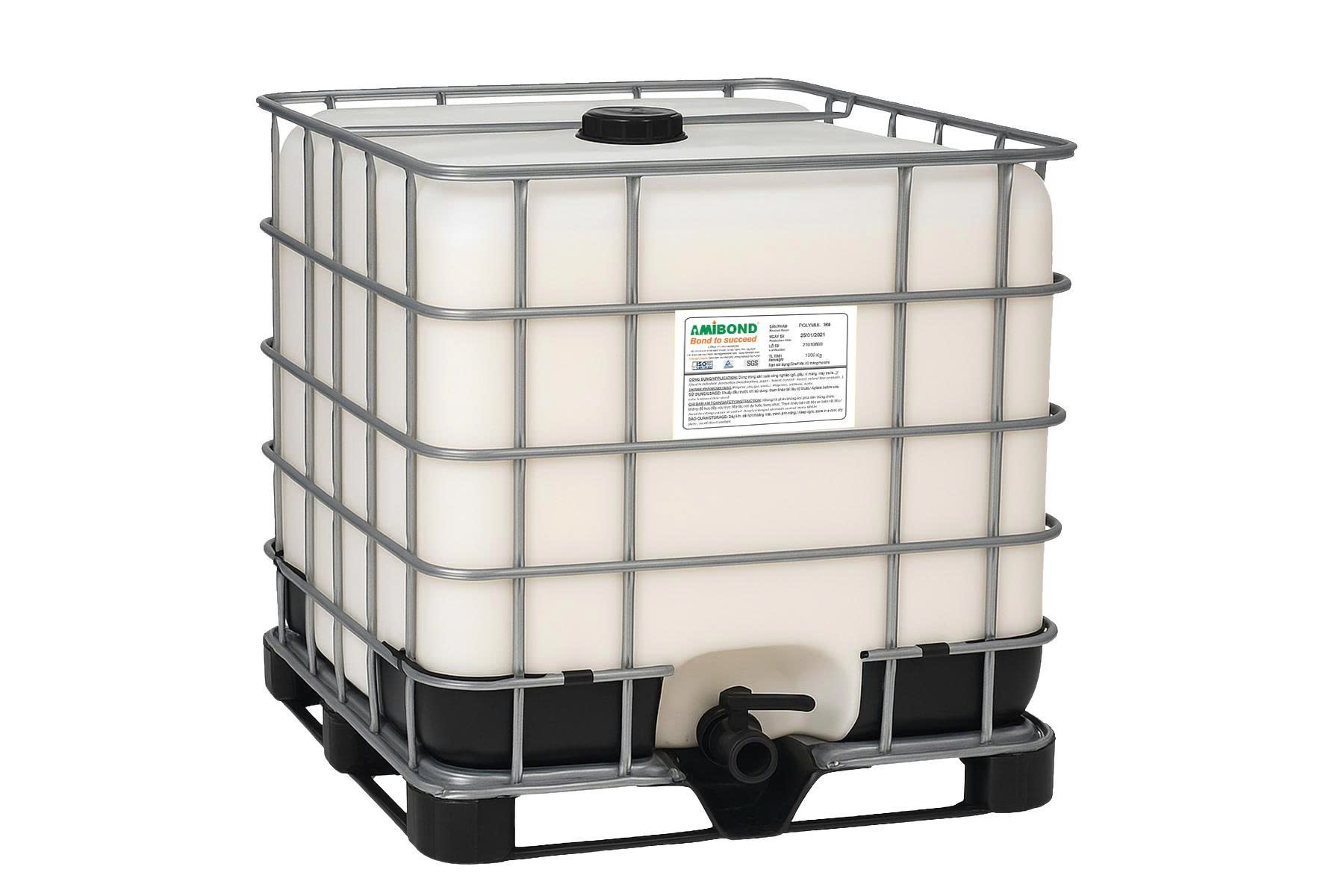
Polyvinyl acetate is a polymer obtained by emulsion polymerization of vinyl acetate monomer in water. The process produces a fine white dispersion, where polymer particles are stabilized by surfactants and protective colloids.
Structurally, PVAc consists of a vinyl backbone with acetoxy groups (–OCOCH₃) that impart polarity and enable hydrogen bonding with hydroxyl-containing materials.
Typical film characteristics include:
- Moderate hardness and flexibility (Tg ≈ 30 °C, depending on formulation).
- Good transparency after drying.
- Compatibility with other polymers and additives such as starch, PVOH, and acrylic or ethylene copolymers.
These properties make PVAc particularly effective for porous and absorbent substrates.
2. Film Formation and Adhesion Mechanism
PVAc emulsions bond through a physical process of film formation typical of latex systems:
- Wetting and penetration: polymer particles spread and penetrate surface pores.
- Water evaporation: interparticle distance decreases as water leaves.
- Coalescence: particles deform and merge into a continuous polymer film.
Adhesion arises mainly from:
- Hydrogen bonding between PVAc and hydroxyl-rich surfaces (cellulose, wood fibers).
- Mechanical interlocking within surface pores.
This mechanism provides excellent bonding to paper, wood, and textiles, but poor adhesion to non-polar materials such as untreated PE, PP, or metals.
3. Technical Characteristics
PVAc emulsions exhibit a combination of desirable performance traits:
- Excellent film formation at room temperature, enhanced by plasticizers or softer copolymers.
- Adjustable viscosity across a wide range for brushing, coating, dipping, or spraying.
- Strong adhesion to cellulose-based substrates.
- Good storage stability, resisting coagulation or phase separation.
- Low environmental impact, as they are water-based and easy to clean.
4. Modifications and Performance Enhancement
To broaden their performance, PVAc emulsions are often modified or copolymerized:
- With ethylene (EVA): improves flexibility and water resistance.
- With PVOH: enhances film strength and rheological stability.
- With acrylic or Veova monomers: increases weatherability and alkali resistance.
Such variations allow PVAc systems to evolve from basic paper adhesives to high-performance formulations for packaging, wood, and building materials.
5. Main Industrial Applications
PVAc adhesives serve a wide range of industrial uses involving porous or fibrous materials:
- Paper and Packaging: for laminating paper layers, carton sealing, envelope and label glues, and paper tube winding.
- Woodworking and Furniture: gor panel lamination, veneer and plywood bonding, and other indoor wood applications requiring clear and flexible adhesive films.
- Textile and Nonwoven: as a binder for nonwoven fabrics and a stiffening or finishing agent for textile materials.
- Natural Fibers and Crafts: gor bonding porous substrates such as paper pulp, natural fibers, or foam-based components.
The common denominator of these applications is that they all involve porous, water-absorbent substrates rich in oxygen-containing functional groups, which are compatible with PVAc’s adhesion mechanism.
6. Advantages and Limitations
Advantages
- Proven and reproducible technology
- Water-based, low-VOC, and safer than solvent adhesives
- Flexible processing methods
- Balanced performance-to-cost ratio
Limitations
- Limited water and heat resistance unless modified
- Weak adhesion to non-polar substrates
Depending on end-use requirements, PVAc can remain in its classic form or be combined with other polymers for extended performance.
7. Summary
PVAc remains a classical yet continuously evolving adhesive system.
Its simplicity, process stability, and formulation flexibility make it a foundational material in water-based adhesive technology.
Despite the advancement of newer polymers, PVAc continues to hold a central and dependable role across modern industrial production thanks to its consistency, adaptability, and balanced performance.